


AI implementation starts with operational excellence, not technology
Many organizations today want to start using artificial intelligence. The pressure to explore AI is high, and new tools, pilots, and use cases are appearing everywhere. In practice, however, many companies start with the technology itself. This leads to a search for possible applications without first understanding what real value can be created within the organization.
Category
Stories
Reading time
5 minutes
For companies looking to improve efficiency, the starting point usually lies elsewhere. Not in AI, but in how the organization can operate more effectively. AI can play an important role in that, but only as part of a broader approach focused on operational excellence.
AI is not a strategy, but an enabler
AI is sometimes referred to as a strategy. In practice, that is often misleading. Companies used to talk about a ‘digital strategy,’ while digitalization was simply part of the overall business strategy.
The same applies to AI. Artificial intelligence is not a goal in itself, but a tool that can help make processes more efficient, improve decision-making, or automate repetitive work. When organizations start from technology, there is a real risk that AI is applied without a clear understanding of the problem it is meant to solve.
That is why AI fits better within a broader operational excellence strategy. One that does not start from tools, but from understanding where processes can be improved, accelerated, or made more efficient.
Operational excellence starts with process insight
Many organizations have less visibility into their processes than they assume. Processes span multiple teams and systems, responsibilities are not always clearly defined, and exceptions make processes more complex than they appear on paper. When new technology is introduced in such an environment, it is often layered on top of existing inefficiencies.
A more effective approach starts with analyzing the operational reality. A useful way to do this is by looking at processes through three connected dimensions: people, process, and technology.
The people dimension focuses on governance, responsibilities, and skills. Are decision rights clearly defined, and is ownership of processes clear? The process dimension looks at process maturity: how standardized processes are, how well they are measured through KPIs, and how often exceptions or manual interventions occur. The technology dimension focuses on the systems that support processes, how well they are integrated, and the quality of the data they rely on.
Looking at these three dimensions together provides a clear view of where the main improvement opportunities lie.
Where AI can actually create value
This does not mean AI has no role to play. On the contrary, there are many processes today where AI can deliver clear value.
In finance, AI can help automatically process documents, match invoices with purchase orders, or forecast cash flow. In customer support, it can analyze incoming requests, route customers to the right specialist, or automate first-line support. In sales, AI can support lead scoring, pipeline analysis, or the generation of quotes and proposals.
In operations and supply chain, applications such as demand forecasting, production planning, and route optimization are becoming more common. In HR and internal operations, AI can be used for CV screening, internal knowledge bases, or automatically identifying action points from meetings.
The question is not whether use cases exist. They clearly do. The real challenge is determining where AI will have the most impact.
Start with bottlenecks, not use cases
Many organizations try to define AI use cases before fully understanding their processes. This often leads to experiments that have limited impact on operational performance.
A more effective approach is to start by identifying bottlenecks within the organization. For example, does information need to be processed and interpreted at scale? Are decisions being made that are largely data-driven? Is there a need to generate content or coordinate work across teams?
When these questions are addressed within the context of existing processes, it becomes much clearer where AI can play a role and where other improvements are more relevant.
From operational excellence to targeted AI initiatives
Once processes, bottlenecks, and maturity are clearly understood, it becomes possible to prioritize improvement initiatives. Instead of starting from technology, organizations can build a roadmap based on operational value.
In that context, AI becomes a means to deliver concrete improvements. In some cases, it will be the right solution. In others, the answer may lie in simplifying processes, strengthening governance, or improving system integration.
For organizations aiming to improve efficiency, a structured analysis of processes is often a valuable first step. ACOMPANY supports this through an operational excellence assessment, analyzing processes across the dimensions of people, process, and technology. By combining process mapping, stakeholder interviews, and maturity analysis, organizations gain a clear understanding of where they can improve their operational performance.
Based on that insight, it becomes possible to determine where technology, including AI, can truly make a difference.
Frequently asked questions about digital transformation
Where should companies start with AI implementation?
Companies should start AI implementation by analyzing their business processes, not by selecting tools.
Without a clear understanding of how processes work, AI initiatives often fail to deliver value. A structured analysis of people, process, and technology reveals where inefficiencies exist and where improvement is possible. From there, AI can be evaluated as one of several ways to improve operational performance.
To see how this type of analysis is structured, explore ACOMPANY’s approach to business analysis and strategy development.
Is AI a strategy or part of a broader transformation?
AI is not a standalone strategy. It is part of a broader operational excellence strategy. AI should support business objectives such as efficiency, scalability, and better decision-making. Organizations that focus on improving processes and governance first are better positioned to use AI effectively. This ensures that AI initiatives are aligned with real operational needs rather than driven by technology alone.
How do you identify the right AI use cases?
The best way to identify AI use cases is to start from operational bottlenecks. Instead of brainstorming ideas in isolation, organizations should look at where work slows down, where manual effort is high, or where decisions rely heavily on data. Questions about information processing, decision-making, content generation, or coordination often reveal where AI can add value. In some cases, process redesign or system integration may be more relevant than AI.
What does an operational excellence assessment include?
An operational excellence assessment analyzes processes, governance, and technology to identify improvement opportunities.
It typically includes process mapping, stakeholder interviews, and maturity analysis across people, process, and technology. The outcome is a clear view of current performance and a roadmap that connects strategy with execution.
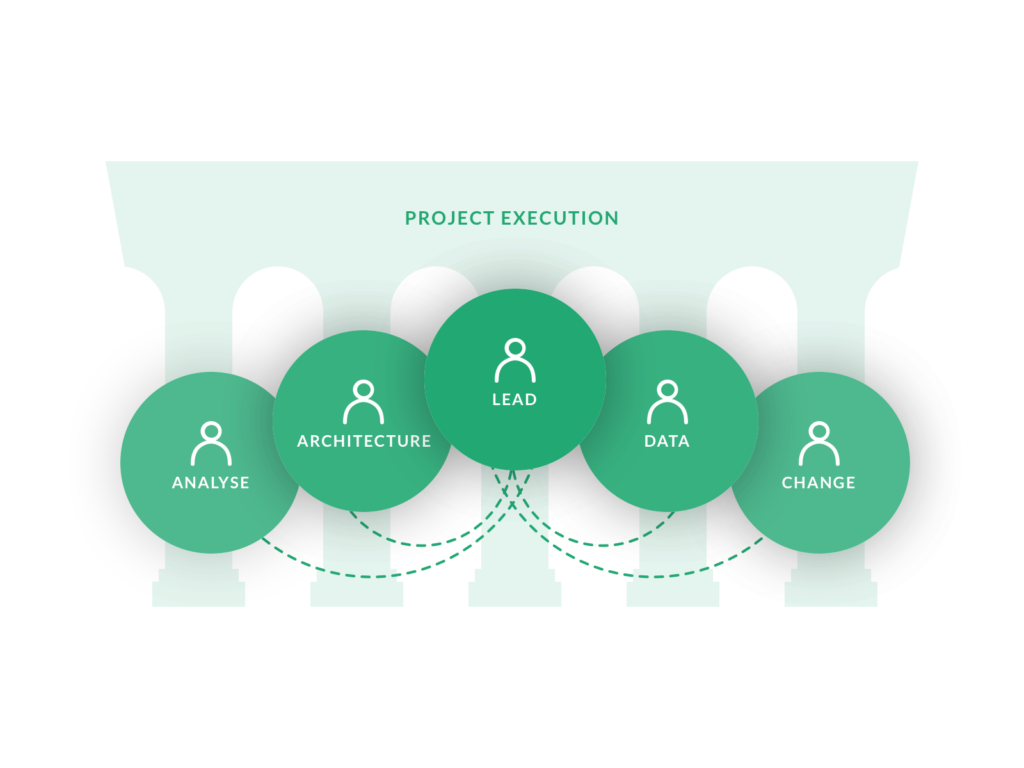
ACOMPANY supports this through strategic, architectural, and execution services, including business design, roadmap definition, and change management.
Reliable partner
Ready to face the digital future with confidence? Then we are here for you.
Recent stories
Stay informed
Would you like to know more about strategic advice, pragmatic implementation, and tangible results of a digital transformation? Sign up for our newsletter now.
