

Why project execution can no longer be a one-man show
Project execution is still too often seen as something you assign to one strong individual. In reality, that approach is becoming less effective. As projects become increasingly interconnected with other systems, processes and teams, success depends less on the profile itself and more on how execution is organized. In many organizations, this also creates a structural risk.
The project relies on one person, one perspective and one way of working. As long as everything goes according to plan, this may seem to work. But once multiple domains come together (architecture, data, change management and integrations) the knowledge of one person often proves insufficient. That is where an agency model demonstrates its added value.
Category
Stories
Reading time
6 minutes
When organizations launch an important project, the reflex is often the same: they need someone to take the lead. Someone who keeps oversight, makes decisions and ensures progress. In practice, this usually comes down to a single profile. A project manager, sometimes complemented with some analysis or architecture knowledge. Or, as is often implicitly expected: the mythical five-legged sheep. That choice seems logical. One person creates speed and clarity, and makes the project easier to start.
But at the same time, there is a clear limitation. Anyone who has experienced a digital transformation or ERP project up close knows these are rarely linear journeys. New questions arise, assumptions are challenged and decisions impact multiple domains at once.
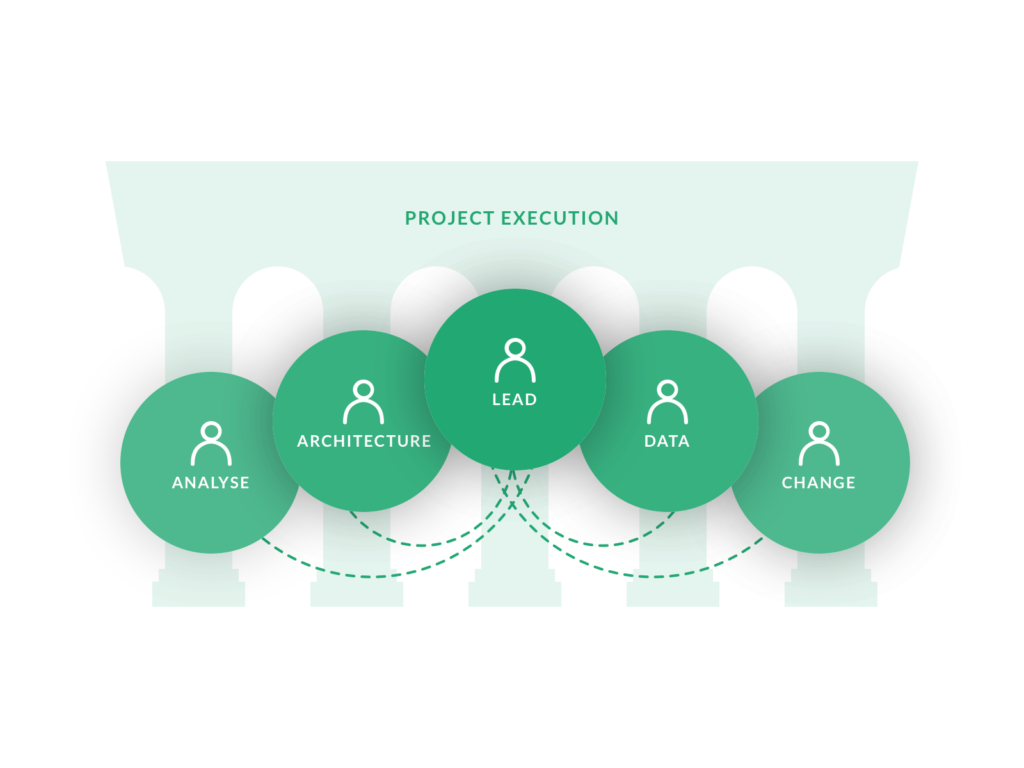
Who leads the project is one thing. But how you organize execution determines whether a project accelerates or slows down. An agency model combines the best of both worlds: one clear point of contact, supported by a team of specialists in analysis, architecture, data and change, who can be deployed flexibly whenever the project requires it.
1. Structured execution creates calm and predictability
Many projects start pragmatically, but quickly evolve into an ad hoc way of working. Decisions and meetings emerge along the way without a clear structure, and eventually much depends on how one person drives the project.
An agency model starts from a different logic. Execution is organized through clear governance or a predefined project framework, with a fixed rhythm of meetings and checkpoints.
Not as bureaucracy, but as a way to keep everyone aligned and make timely adjustments. That structure is also adapted to the scale and complexity of the project. No unnecessary overhead, but enough guidance to make risks visible and accelerate decision-making. What initially looks like extra structure actually creates more speed and less noise in practice.
This translates into faster decisions and fewer project delays.
2. One point of contact, backed by a team
Simplicity remains important. Clients want clarity and one point of contact who takes responsibility. That does not change in an agency model.
The difference happens behind the scenes. Where one person in a traditional setup often operates alone, in an agency model that person is supported by a team. This means decisions are not driven by a single perspective, but informed by multiple viewpoints and experiences.
For the client, the interaction remains simple. But the quality of execution is strengthened by the collective intelligence operating in the background. Because decisions are immediately viewed from different angles, you also avoid having to revisit choices later on.
3. The right expertise at the right moment
In many projects, organizations look for someone who can do everything: project management, analysis, architecture, data and change management. At the same time, projects continuously evolve during execution: new integrations appear, additional data questions emerge and the scope changes. In reality, it is rarely feasible to combine all that expertise in a single profile.
An agency model starts from a more realistic assumption. You deploy a strong generalist who leads the project and has sufficient breadth to understand connections across domains.
In addition, specialized expertise in analysis, architecture, data or change can be added flexibly whenever the project requires it. This allows new needs to be addressed without slowing down the project or reorganizing the entire setup.
This means you do not need to compromise. You do not have to let someone without deep architectural knowledge make architecture decisions, or entrust complex analyses to someone who only partially understands them. You combine breadth and depth without forcing everything into one profile. Decisions are also made faster and with better substantiation because different areas of expertise come together around the same project. This directly results in less rework, fewer discussions afterwards and shorter lead times.
It also prevents important decisions from being made too late or based on limited input, which often leads to rework and additional costs.
4. Less dependency means lower project risk
Finally, there is another structural risk that is underestimated in many projects: dependency on one profile. When critical knowledge resides with one individual, vulnerability automatically arises. If that person becomes unavailable or additional expertise is needed, the project almost immediately slows down.
An agency model removes that dependency. Knowledge is shared, documented and safeguarded within the team. The way of working is standardized, making handovers faster and smoother. As a result, knowledge remains within the project and fewer delays occur due to handovers, resource gaps or unexpected changes.
This not only reduces the risk of delays, but also makes projects less vulnerable to change.
Project execution is no longer a one-man show
Today’s digital transformation projects require more than one strong profile. They require structure, collaboration and the ability to quickly bring in the right expertise when needed.
That is exactly why an agency model makes the difference: not in theory, but in the daily reality of project execution.
Are you preparing for an important project and wondering whether your current approach is still sufficient? We would be happy to think along with you.
Frequently asked questions about digital transformation
What is an agency model in project execution?
An agency model is a project execution approach where one central point of contact is supported by a team of specialists in areas such as analysis, architecture, data and change management. Instead of relying on one individual to cover every domain, expertise can be added flexibly whenever the project requires it. This creates more structure, better decision-making and lower project risk.
Why are digital transformation projects difficult to manage with one person?
Digital transformation projects involve multiple domains, systems and stakeholders. Decisions in one area often impact architecture, data, integrations or organizational change elsewhere. Because of this complexity, relying on one person creates risks around limited expertise, bottlenecks and dependency. A collaborative execution model provides broader expertise and more resilient project delivery.
How does an agency model reduce project risk?
An agency model reduces project risk by spreading knowledge across a team instead of concentrating it with one individual. Processes, governance and ways of working are standardized and documented, making projects less vulnerable to resource changes, delays or knowledge gaps. This improves continuity and reduces the impact of unexpected changes during execution.
What are the benefits of structured project execution?
Structured project execution improves alignment, decision-making and predictability. By working with clear governance, predefined frameworks, checkpoints and regular meetings, organizations can identify risks earlier and avoid ad hoc decision-making. This often results in faster execution, fewer delays and less rework throughout the project lifecycle.
Why is the right expertise at the right moment important in project execution?
Projects evolve continuously. New integrations, data requirements or organizational changes can emerge during execution. Having access to specialized expertise exactly when needed allows organizations to make better-informed decisions without slowing down the project. This combination of broad oversight and targeted expertise leads to higher-quality execution and more efficient project delivery.
Reliable partner
Ready to face the digital future with confidence? Then we are here for you.
Recent stories

Stay informed
Would you like to know more about strategic advice, pragmatic implementation, and tangible results of a digital transformation? Sign up for our newsletter now.
