


ERP success does not start with technology, but with collaboration
An ERP implementation is rarely a purely technical project. In practice, the success or failure of such a journey depends on the collaboration between customer and vendor. Clear agreements, mutual trust, and people who are willing to make decisions are essential. That is precisely where things often go wrong. Organizations underestimate the impact on their people and processes, while governance risks becoming fragmented. That is why more and more companies choose to bring in a guiding partner. Not to take over the project, but to provide structure and align everyone toward the same goal.
Category
Stories
Reading time
6 minutes
What does such a collaboration look like in practice? When does it work as a magical triangle, and when does it risk turning into a Bermuda Triangle? We discussed this with Thibaut Heeren, Business Unit Manager Unified Operations at Cegeka.
When do you say: “this was a successful ERP implementation”? And I don’t mean just time & budget, truly successful.
Thibaut Heeren: In the short term, you naturally still look at the classic four pillars: scope, timeline, budget, and quality. If those are right, you have a good go-live. But honestly? That is only the beginning. Today, many organizations consciously choose an MVP approach (Minimal Viable Product). Not to get something live quickly, but to create value from the investment early and to be able to adjust quickly where needed. By starting small and scaling based on what has been tested and validated in the first phase, you create a solid blueprint for a high-quality rollout of phases two and three. That is ultimately where the greatest value of the project lies. You therefore only measure success months or even years after go-live.
Of course, expectations need to be managed. If customers continue to invest, keep improving, and finally let go of their old Excel files, then you know things are going well. Managing expectations mainly means clearly defining the concrete value the organization wants to realize. Think of better-served customers, time savings in core processes, less manual or duplicate work, or more transparency in decision-making.
That is why we also advise customers to define a number of tangible KPIs in advance. These measurement points return at different moments throughout the journey, so organizations can clearly see the progress they are making and where adjustments are needed.
What customers often underestimate in an ERP journey
What do you think are the most important things a customer needs to do themselves to make an ERP project successful?
Thibaut Heeren: The biggest success factor lies on the customer side, and it starts with expectations. We always ask: is your organization truly ready for this? An ERP project requires a lot of time from key users and business process owners. More than ever before. We often apply a factor of one to one and a half days of customer effort for every day we deliver. For many organizations that comes as a shock, but if you don’t do this, things will go wrong. There is genuinely a lot involved for the customer, for example when it comes to testing the application or delivering data.
As a customer, you cannot simply park an ERP project with a partner and expect it to work out by itself. Employees have to do this on top of their regular jobs. If you underestimate that, you will get delays, frustration, and ultimately disappointment.
At what point do you see that it becomes difficult for a customer to keep pulling everything themselves, and that a guiding partner really helps?
Thibaut Heeren: That moment often comes when customers realize they cannot live up to the required time investment. When they see they cannot free up certain key people one day per week for the project. Or when there is insufficient governance internally. That is when we recommend bringing in a guiding partner. That may be an additional cost, but a project that derails because no one has the time or overview, ends up costing much more.
The most successful projects I have seen, had such a partner on board. Not because they take over everything, but because they help structure the work, set priorities, and facilitate difficult conversations.
The magical triangle: collaboration without noise
You then have three parties that need to collaborate. When does that work as a magical triangle? And when does it become a Bermuda Triangle in which the project disappears?
Thibaut Heeren: That triangle only works if there is trust and clear agreements. Who does what? Who decides? Who escalates when things go wrong? These things need to be defined upfront, for example in a RACI workshop (Responsible, Accountable, Consulted, Informed). Otherwise, responsibilities disappear and you indeed end up with a Bermuda Triangle. Such a RACI really goes into detail on all tasks. Take testing, for example: it often needs to be split into 12 subtasks, handled by different people. There can be no ambiguity about all those small but crucial elements.
“The best collaborations are those where, in the end, you no longer know who belongs to which party. Then there is one ‘dream team’ in which everyone sees each other as colleagues. But that is only possible if you are very sharp about roles and responsibilities at the beginning. As the saying goes: “Good agreements make good friends.”
What does a good guiding partner really need to be able to do?
Thibaut Heeren: They need to dare to say what needs to be said. To us and to the customer. If we do something wrong, that needs to be called out. That is precisely why the MVP phase I mentioned earlier is so important: to surface issues early, when adjustments are still easy. What is learned in that first phase helps avoid mistakes and inefficiencies in later phases. In that way, the MVP becomes not a risk, but a strategic lever for long-term quality. But the guiding partner also needs to push back when the customer does not live up to their commitments. They sit somewhat in the middle as a moderator, with enough distance to remain honest.
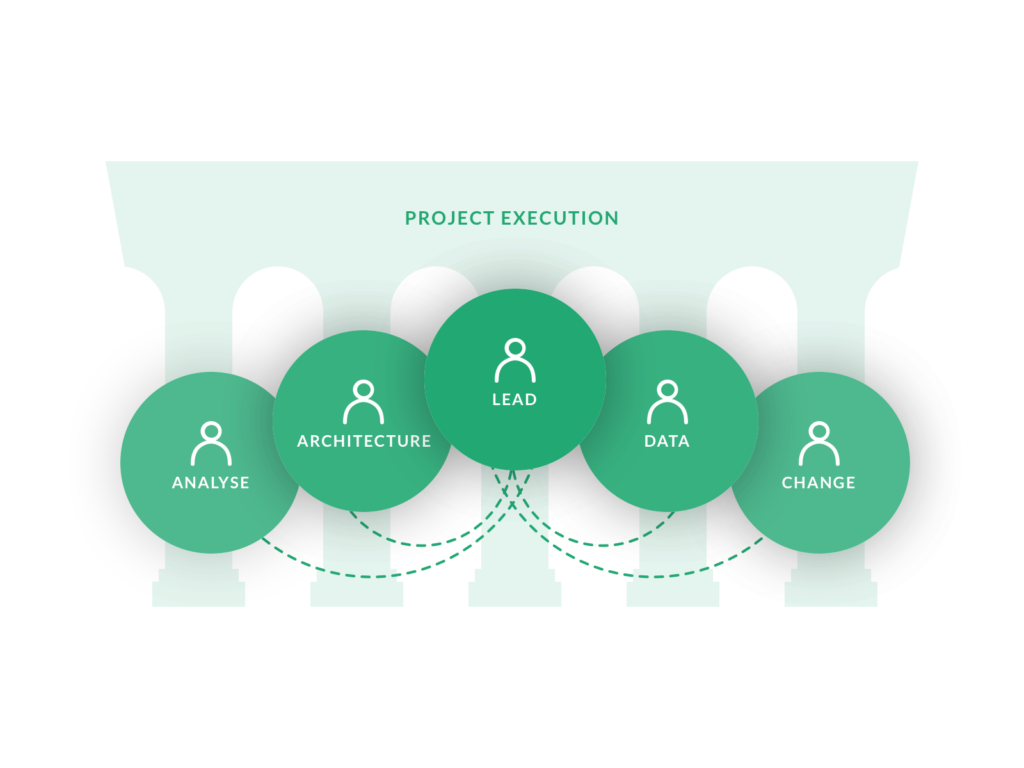
In addition, they need to maintain an overview of the entire landscape. ERP rarely stands alone. There are integrations, other vendors, other interests. Someone needs to keep seeing the bigger picture and ask the right questions. Getting all those vendors to work together in the right way is a very special task for that moderator.
What a good guiding partner truly needs to be able to do
Cegeka often advises customers to talk to multiple guiding partners before making a choice. In which situations do you think: “ACOMPANY really fits well here”?
Thibaut Heeren: We are very deliberately not exclusive in this, and ACOMPANY is not either. We always recommend two or three parties, depending on the context, the region, and any specific expertise required. What makes ACOMPANY strong in my view is their helicopter perspective. They bring structure at the enterprise level and look beyond a single application.
For organizations with a complex application landscape or where long-term choices are important, that is a major added value. They also strongly bridge business and IT, so no one falls into the trap of using technology for technology’s sake. That makes them a strong sparring partner. For the customer and for us. We know they will think along with the customer and have a view on enterprise architecture and the long term.
ACOMPANY also has a lot of experience in change management. Implementing a new ERP package is a major change for an organization, and it needs to be properly guided to prevent the emergence of shadow IT.
When does an ERP project truly feel completed for you?
Thibaut Heeren: When the customer continues to invite us and the guiding partner, even after go-live. Not because something is wrong, but because they see us as partners. Then you are at the table thinking together about next steps, for example when priorities and budgets for the next year are being defined. When that happens, you know the project was more than an implementation. It was a collaboration as one team.
ERP only really works when vendors become partners and partners almost become colleagues. That is when the magical triangle is complete.
Frequently asked questions about digital transformation
Why does ERP success not start with technology?
An ERP implementation is primarily about collaboration, processes, and clear agreements. Without alignment between the involved parties and a shared approach, technology alone delivers little value.
What are the key success factors for an ERP implementation?
Successful ERP projects rely on clear expectations, strong organizational involvement, and effective collaboration between all parties. By focusing on value creation rather than just timing and budget, they deliver sustainable impact.
Why is collaboration between the customer, vendor, and supporting partner so important?
An ERP trajectory requires alignment between multiple stakeholders. When roles, responsibilities, and decision-making are clearly defined, strong collaboration emerges that drives the project forward rather than slowing it down.
How do you prevent an ERP project from derailing?
By ensuring sufficient internal involvement, clear governance, and a strong overview of the entire landscape. A structured approach helps set priorities, manage risks, and make timely adjustments.
How does an ERP implementation fit within digital transformation?
An ERP project is part of a broader digital transformation in which processes, systems, and people are aligned. By framing it within a larger context, such as a master plan and enterprise architecture, it becomes a lever for growth and innovation.
Reliable partner
Ready to face the digital future with confidence? Then we are here for you.
Recent stories

Stay informed
Would you like to know more about strategic advice, pragmatic implementation, and tangible results of a digital transformation? Sign up for our newsletter now.
