


Change management: not a soft edge, but a hard core
Digital transformations are rarely mere technical operations. They bring about fundamental changes in how organizations work, decide and create value. That is exactly why change management is not the soft edge of a project, but an integral part of the core. Anyone who thinks a change manager is only there to massage away resistance or listen empathetically is looking too narrowly. A strong change manager is a substantive professional who helps translate strategy into sustainable change.
Category
Stories
Reading time
3 minutes
From vision to daily reality
A transformation often starts with a sharp strategic ambition. But how does that vision end up in everyday behavior, processes and systems? The change manager plays a key role here: as a bridge between goal and realization, between business and IT, between leadership and the employees who ultimately have to make it happen.
That means: focusing on what is changing – and why. Is it about a new system? A different way of collaborating? Changing customer expectations? New compliance requirements? A good change manager knows how to interpret the context and concretize the impact. He or she maps out who is affected, where friction may arise and how the organization needs to reinvent itself – from roles to processes, from structure to culture.
Architect of transformation
The change manager operates not alongside the project, but at its heart. Together with business, IT and HR, (s)he helps shape the desired target organization: what new roles emerge, what competencies are needed, how do processes and systems align with the new model? In this sense, the change manager is also a transformation architect – someone who helps design and realize the blueprint for change.
That role requires an understanding of both strategy and operations, and of both people and systems. A change manager knows the content at the heart of the project and speaks the language of the various stakeholders. That makes him or her an indispensable interface between program and project teams, process owners, communications managers and HR.
Understanding and commitment
Change requires not only structure and plans, but also commitment. Therefore, the change manager also brings the voice of the employee into the transformation team – just as we talk about the ‘voice of the customer’ in customer-focused projects. How is the change perceived? Where does uncertainty, resistance or overload arise? What support is needed?
You don’t build that commitment with a one-time presentation or a set of slides. It requires clear communication, honest answers and room for dialogue. But also very concrete support: pilot projects, training, coaching, feedback loops. So that employees not only understand what is changing, but also feel that they are able to move with it.
Embedding in daily work
Successful change does not stop at the go-live. The change manager ensures that new ways of working are embedded in processes, tools, roles and behaviors. (S)he ensures that change does not remain something temporary, but becomes ingrained in the organization. This requires follow-up via KPIs, assessments, feedback moments – and the willingness to make adjustments where necessary.
ACOMPANY: content, structure and people
At ACOMPANY we believe that sustainable change is only possible when strategy, content and people come together. Our consultants are not on the sidelines, but partners in the heart of the transformation. They combine in-depth knowledge of processes and technology with experience in behavioral change and organizational dynamics. They help you not only make plans, but land them – and make them work sustainably.
Frequently asked questions about digital transformation
Why is change management crucial in digital transformation?
Digital transformation is not only about technology, but primarily about people, processes, and behavior. Without strong change management, change remains superficial and is not sustainably embedded in the organization.
What does a change manager do in a transformation project?
A change manager translates strategy into daily reality. He or she maps impact, supports employees, and ensures that new processes and systems are effectively adopted.
How do you ensure employees embrace digital change?
Engagement is created through clear communication, active dialogue, and concrete support such as training and coaching. By involving employees from the start, you significantly increase the chances of success.
How do you embed change sustainably in an organization?
Change becomes successful when it is integrated into processes, tools, and behavior. Through monitoring via KPIs, feedback, and continuous adjustment, the organization continues to evolve.
How does change management fit within a broader digital strategy?
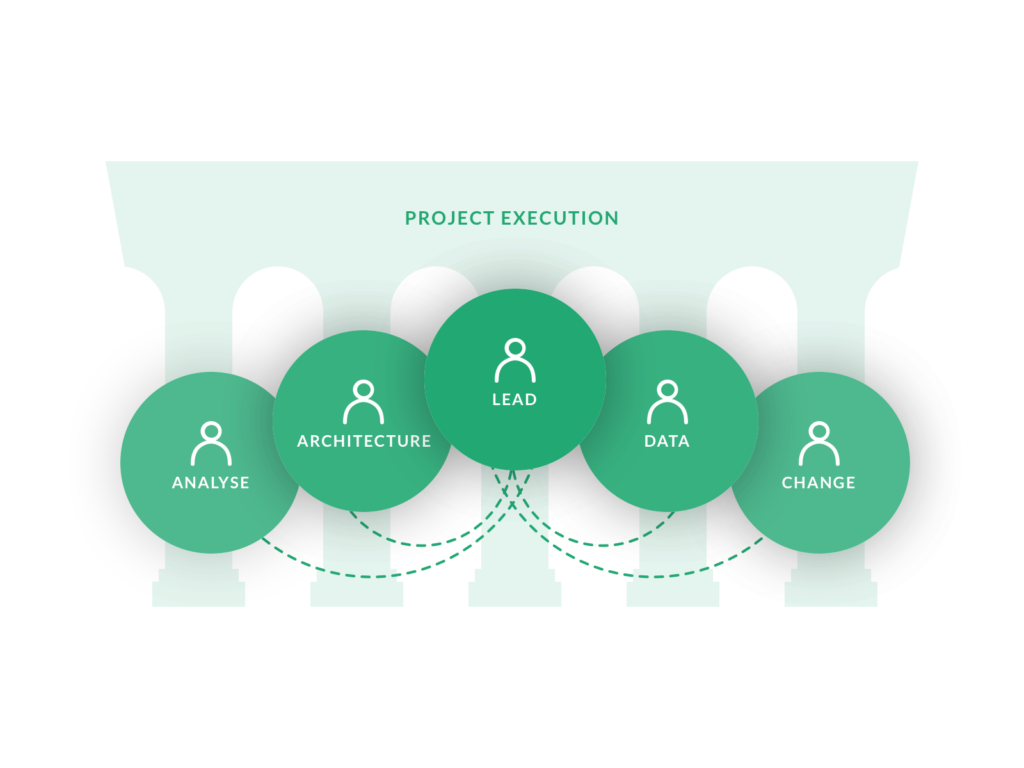
Change management is the link between strategy and execution. Combined with a clear approach, strong architecture, and focused execution, it ensures that digital transformation is not only planned but also realized.
Reliable partner
Ready to face the digital future with confidence? Then we are here for you.
Recent stories

Stay informed
Would you like to know more about strategic advice, pragmatic implementation, and tangible results of a digital transformation? Sign up for our newsletter now.
