
Architecture audit: from maturity to greater business value
Many organizations have established an architecture function. They have architects, models and governance boards in place. Yet that investment does not always deliver the expected value. Project teams sometimes see architecture as an additional step that slows them down. Business leaders see it as something that belongs to IT, while architecture principles are applied only to a limited extent in practice.
Category
Stories
Reading time
5 minutes
At one organization we recently assessed, for example, architecture was highly theoretical. The necessary structures were in place, but project teams received little support in their day-to-day work. As a result, the architecture function risked becoming more of an obstacle than a source of support. An architecture audit therefore examines where architecture helps the organization make better decisions and where there is still room for improvement.
An architecture audit starts with the business question
The focus of an audit differs from one organization to another. Sometimes the application landscape has become so complex that rationalization is needed. Elsewhere, the challenge lies in project prioritization: are the initiatives that deliver the greatest business value also receiving the most attention? Silos can be a hindrance too, for example when different domains develop separate solutions for similar needs.
The business question determines where the assessment should focus. This prevents a maturity assessment from becoming a theoretical exercise that mainly produces a score.
An architecture audit examines five architecture domains
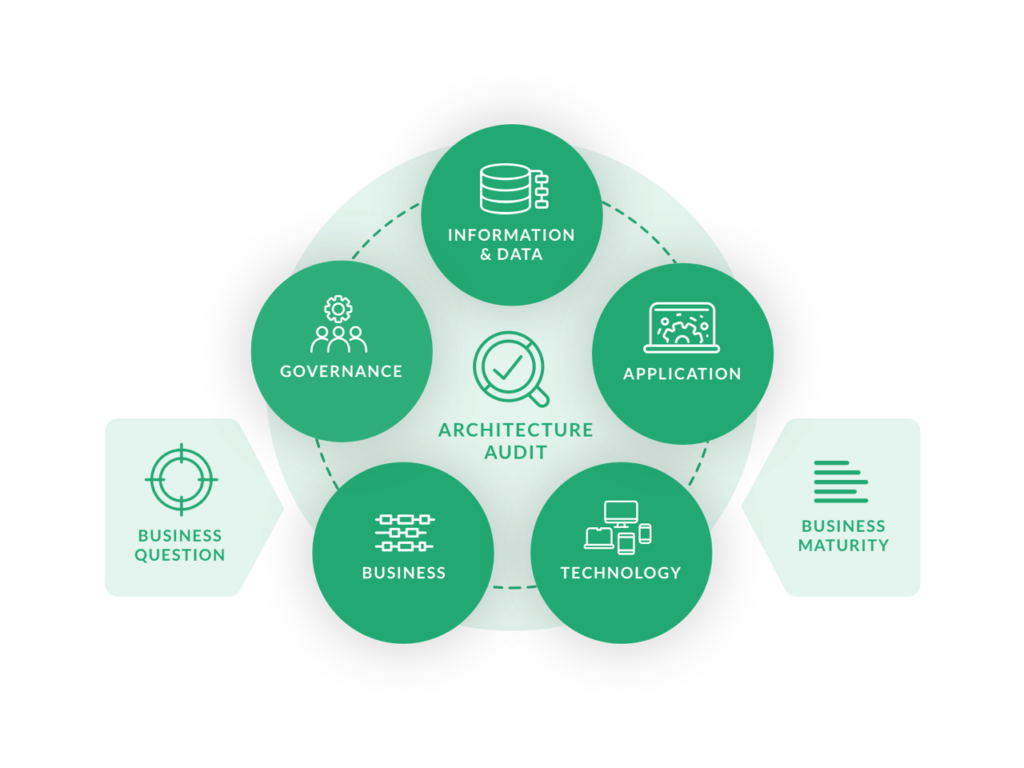
ACOMPANY uses five domains to assess the architecture function, depending on the focus: Business, Application, Information & Data, Technology and Governance. For each domain, we review the available architecture artifacts and speak with the stakeholders who use them. This allows us to assess whether what has been formally defined also plays a role in day-to-day operations. An application inventory, for example, has little value if no one is responsible for maintaining it. The same applies to a business capability model that plays no role in investment decisions.
The interviews then reveal how stakeholders experience the formal architecture function in practice. During one audit, for example, architects assumed that a particular artifact was actively being used. Conversations with other stakeholders painted a different picture: some were barely aware of it, while others did not know when they were supposed to use it.
Architects may believe they take business needs into account when making decisions, while business leaders feel they are involved too late. Differences like these help explain why an architecture function can appear well organized on paper but have less impact in practice.
Architecture maturity depends on the organization's ambition
In addition to current maturity, the audit identifies the role the organization wants architecture to play in the future. Not every domain needs to reach the same maturity level. The desired maturity depends on the organization’s objectives and context. A company looking to rationalize its application landscape will have different priorities from an organization primarily seeking to align its investments more closely with strategic priorities.
An architecture function does not progress from maturity level one to five within a few months.
New responsibilities and decision-making processes need to become part of day-to-day operations. The roadmap therefore takes into account what the organization can realistically absorb at each stage.
Some improvements are relatively easy to implement. During one engagement, for example, employees were unclear about whom to contact with architecture-related questions. Clarifying the appropriate points of contact delivered quick results, while further development of governance was incorporated into the roadmap.
Architecture needs to fit the existing organization
The continued development of the architecture function needs to align with the way the organization operates. How does project governance work? When does architecture become involved? What responsibilities sit with the PMO? And how do existing architecture roles fit into that structure?
The answer differs by stakeholder group. A project manager interacts with architecture differently from a business leader or an architect. The way of working needs to reflect those differences.
During another engagement, a new architecture model was therefore tested in a number of pilot projects first. Users kept a ‘friction log’ to record where the new way of working conflicted with existing processes in practice. Those experiences provided input for refining the model before the broader rollout.
Change communication supports this transition by clarifying the role employees play and when architecture becomes part of a decision.
Why an external perspective adds value to an architecture audit
An architecture audit quickly touches on existing responsibilities and internal interests. For employees who work within that structure every day, it can be difficult to view it from a distance.
An external party brings together the different perspectives and compares them with the available artifacts. This reveals differences between what has formally been agreed and what stakeholders experience in practice. It provides a starting point for setting priorities together with the organization.
A mature architecture function requires ongoing direction
Architecture affects how projects are managed and how decisions are made. Developing the architecture function is therefore also an organizational change.
This requires day-to-day direction and sufficient authority. Sponsorship from the CIO and other relevant executives helps embed architecture beyond the architecture and IT teams.
Want to know where your architecture function creates value today and where there is room for improvement? Contact ACOMPANY.
Frequently asked questions about architecture audits
What is an architecture audit?
An architecture audit examines how architecture is organized within an organization and how it is used in practice. ACOMPANY assesses five domains: Business, Application, Information & Data, Technology and Governance. The audit combines an analysis of architecture artifacts with stakeholder interviews to determine where architecture adds value and where improvements are needed.
When is an architecture audit useful?
An architecture audit is useful when the architecture function is not delivering sufficient value, the application landscape is becoming complex, or projects are not sufficiently aligned with strategic priorities. The specific focus starts with the organization’s business question and may include areas such as rationalization, governance or better investment prioritization.
How do you determine the right maturity level for enterprise architecture?
The desired maturity level depends on the organization’s ambitions and context. Not every architecture domain needs to reach the same level. An architecture audit therefore assesses both current maturity and the desired role of architecture, providing the basis for a realistic roadmap.
How do you ensure enterprise architecture is used in practice?
Architecture needs to align with existing project governance, responsibilities and ways of working. This includes clearly defining when architecture should be involved, who is responsible for what, and how different stakeholders work with architecture. Pilot projects help test and refine a new approach in practice before a broader rollout.
Why use an external party for an architecture audit?
An external party can bring together different perspectives within the organization and compare them with the available architecture artifacts. This reveals differences between formal agreements and how stakeholders actually experience and use architecture, giving the organization a solid basis for setting priorities.
Reliable partner
Ready to face the digital future with confidence? Then we are here for you.
Recent stories

Stay informed
Would you like to know more about strategic advice, pragmatic implementation, and tangible results of a digital transformation? Sign up for our newsletter now.